Change anyone?

We can all think of things we’d like to have changed.

How many New Year’s resolutions to change something – lose weight, exercise more, be nicer to the mother-in-law – have you heard people express? How long do they last? Change is not easy, even on this personal level when you are the one supposedly calling the shots.

We might want something to change, but when it’s us that needs to change, that’s not so popular.

What about when it’s something in the community where lots of people might be affected? Who will take the lead, and get things going? What is the role of volunteer community groups in leading change?

We are lucky to have a new independent newspaper in our area – EastSider News so now community groups seeking to make lives better for everyone have a chance to tell others what they are doing. EastSider News itself came about by a very small group deciding that they would help to bring about change by publishing this newspaper. They put their hands up to lead the change.

There are a many community groups, but not all are trying to change things. In fact many mainly want to make it easier, more fun, or have more engagement with like-minded people when they do whatever the group is set up to do. That might be playing cards, soccer, being wonderfully creative with wood or a thousand other things.  Many of these have excellent social side-benefits and are to be highly recommended.

Some groups want changes that will benefit everyone.  They recognise everyone in the community as a being a member of their group.

As an example, no matter your views on climate change and its causes, groups who seek to change policies of governments at all levels to mitigate and counter the effects of climate change are not acting out of self-interest.  The change they seek will benefit everyone.  Some might oppose this view because their own self-interest is being threatened, not because they think the wider community interest is being threatened. Some will perceive the change being sought to be a political one and they oppose it because it conflicts with their own political views.

WATAG seeks to share the benefits of safe and convenient walking and cycling activities for leisure and local commuting for all. Members  are strong advocates for infrastructure improvements which will be to everyone’s benefit, not just their own.

By joining a local environment group such as Lighter Footprints (lighterfootprints.org) , or an Active Transport advocacy group like WATAG, being a maintenance volunteer in your local park, or helping meals-on-wheels, you can be a contributor to change for everyone’s benefit. You can help lead the change.

Recent changes to the Local Government Act here in Victoria require local Councils to implement a Community Engagement policy by 1st March 2021. It is regarded as very important for people in the community to be able to have a genuine say in how their community is evolving around them. And not just to have a say, but to have influence on decisions, and help make those decisions – to be a contributor to change.

So… getting involved with your Council can have a big effect.  It can lead to change.

Look out for any opportunities your Council gives to provide input.  If you see something that you think could be done better, let your Council or other authority know.  The app called Snap Send Solve  is a great way to do this.

You too can bring about changes for everyone’s benefit. Become a WATAG subscriber – or better still become a WATAG Member!

Posted in Active transport | Leave a comment

Latest WATAG newsletter

Click here for Active Whitehorse News February 2023


Posted in Active transport | Leave a comment

Back to school

But will it be different from previous years?

Much has been written about the Covid effects of children missing vital experiences at school due to Covid-created absences. One very positive effect of Covid was that, early on at least in Victoria, there were no cars on our local streets and children could go out and about with their parents and use the streets with much increased safety.

Image credit: Unknown source

Now that all seems ‘normal’ again, will the community forget the positive aspects and revert to old habits by driving children to school instead of encouraging walking or riding, or even scooting?

The practice of children walking or cycling to school has so many benefits, both for the individual child and for the community as a whole. We’ve highlighted these amazing benefits before. But it’s worth reiterating them so we don’t go back to our old pre-Covid ways. Check these out:

Importantly, these benefits are backed by Australian research and expert opinions:

  • Improved Physical Health Walking or cycling to school provides children with a daily dose of physical activity, which can help them maintain a healthy weight and improve cardiovascular health. According to a study by the Australian Government Department of Health, “regular physical activity in childhood and adolescence is associated with a reduced risk of cardiovascular disease in adulthood.”
  • Enhanced Mental Health and Learning Walking or cycling to school has been shown to improve children’s focus and concentration in the classroom. A study by the University of Western Australia found that “students who walked or biked to school demonstrated better cognitive function and were more alert in class compared to their peers who were driven.”
  • Increased Independence and Self-Esteem When children are allowed to walk or cycle to school, they develop a sense of independence and self-esteem. This can be particularly important for children who do not have a lot of freedom or control in other aspects of their lives.
  • Reduced Traffic Congestion and Air Pollution The more children who walk or cycle to school, the fewer cars on the road, which reduces traffic congestion and air pollution. According to the New South Wales Government’s Environmental Protection Authority, “traffic is the leading environmental cause of death for children and young people.”
  • Safer Communities Walking and cycling routes to schools that are safe, accessible and well-lit can help create safer communities. According to a report by the Victoria Government’s Transport Accident Commission, “students who walk or bike to school are more likely to feel connected to their community and less likely to experience bullying or other negative experiences.”

In conclusion, there are numerous benefits to children walking or cycling to school instead of being driven. By encouraging children to be active and engaged in their communities, we can help to promote their health and wellbeing, as well as make our communities safer and more environmentally friendly.

Sources:

  1. Australian Government Department of Health, “Physical Activity and Health: A Report of the Surgeon General”
  2. University of Western Australia, “Active Transportation and Academic Performance”
  3. New South Wales Government’s Environmental Protection Authority, “Healthy Cities and Urban Development”
  4. Victoria Government’s Transport Accident Commission, “Creating Safe, Walkable, Bikable Communities”

    Overseas Sources include:

    1. National Institutes of Health, “Physical Activity and Health: A Report of the Surgeon General”
    2. University of Illinois, “Active Transportation and Academic Performance”
    3. World Health Organization, “Healthy Cities and Urban Development”
    4. National Center for Safe Routes to School, “Creating Safe, Walkable, Bikable Communities”

    It’s compelling evidence. But are our local and State Governments really listening? Their budgets and actions don’t seem to indicate they have heard the message well enough.

    Posted in Active transport | Leave a comment

    Scooting around

    Photo credit: A man riding a hire scooter without a helmet in the CBD.Credit:Luis Ascui The Age January 6, 2023

    Micro-mobility is contentious because e-scooters can be threatening to pedestrians. It is claimed that using e-scooters is a replacement for short car trips and therefore environmentally sound. But these claims are generally made by scooter hire companies who stand to profit from e-scooter use. There is a trial in Melbourne. Is there any unbiased research on the usage and benefits and disadvantages?

    Well – yes, there is research on the usage and benefits and disadvantages of e-scooters and micro-mobility in general. However, the findings can vary depending on the study and the context in which e-scooters are used. Some studies have shown that e-scooters can lead to reductions in car trips and emissions, while others have found that e-scooters may increase pedestrian-vehicle conflicts. The results of the trial in Melbourne may provide further insights into the effects of e-scooters in a specific context.

    Here are some of the general findings from research on the usage and benefits and disadvantages of e-scooters and micro-mobility:

    • Environmental benefits: Some studies have shown that e-scooters can lead to reductions in car trips and emissions, particularly for short trips.
    • Accessibility: E-scooters can improve mobility options for people who cannot or prefer not to drive, including those who are elderly, disabled, or low-income.
    • Safety: There is concern that e-scooters can pose a threat to pedestrians, cyclists, and other road users, particularly in densely populated areas. Some studies have reported high rates of e-scooter-related injuries and accidents.
    • Congestion: E-scooters can contribute to increased sidewalk and street congestion in densely populated areas, leading to conflicts between pedestrians and riders.
    • Equity: Access to e-scooters can be limited for certain populations, such as those who do not have access to a credit card or smartphone.

    A few academic studies that have looked at various aspects of e-scooters and micro-mobility are:

    • “Electric Scooters and Bikesharing: Impacts on Public Transit Use and Physical Activity.” (2020) by M. Shaheen, C. Cohen, R. Jones, and L. Banister. Transportation Research Part A: Policy and Practice, volume 137.
    • “Electric Scooters and Public Space: Understanding User Experiences and Perceptions.” (2020) by K. Blanke, M. Rosales, and A. Manaugh. Transportation Research Part A: Policy and Practice, volume 142.
    • “The Environmental and Health Impacts of E-Scooters: A Review.” (2020) by E. Moretti, S. Mandaville, K. Froehlich, and M. Jerrett. Transportation Research Part D: Transport and Environment, volume 83.
    • “The Impacts of Electric Scooters on Physical Activity, Health, and Safety.” (2021) by B.A. Baumeister and K. Brien. Journal of Transport & Health, volume 19.

    These studies provide a good starting point for exploring some of the benefits and drawbacks of e-scooters and micro-mobility, but there is much more research being done in this field, and the findings are constantly evolving.

    These findings suggest that the impact of e-scooters and micro-mobility is complex and context-dependent. So it’s important to consider the potential benefits and drawbacks in a comprehensive and nuanced manner, and consider various aspects such as safety, accessibility, and actual rather than perceived sustainability.

    A personal perspective from the editor.

    Being a recent immigrant into the area that may well be termed “scooter central” – Southbank along the Yarra River Melbourne – and looking out my apartment window, and in the surrounding streets and shared paths along the river, I’ll give a non-academic perspective. It’s not based on surveys or rigorous double-blind testing, but simply personal observation.

    It’s my view that e-scooters are principally for people to have fun on. They ‘double-dink, helmets seem optional, the rule about not riding on footpaths it totally ignored, and they simply get discarded like McDonald’s wrappers when the fun had been had. Their mothers never insisted on them putting things away in an orderly way when you finish using something!

    Sure, some do get used for commuting. A recent Bicycle Network count done on one city entrance from7am – 10am on a Tuesday, recorded 319 cyclists and 26 scooters. Probably almost all were commuters, and all were acting in an orderly way. But visual observation along the river path – particularly or a weekend, and it’s hundreds of ‘fun trips’ and not an office-backpack or briefcase in sight.

    In summary

    Let’s hope those evaluating the Melbourne trial are not too swayed by the commercial operators data, and get on the streets themselves and observe the actual behaviours as well as all the academic research.

    Posted in Active transport | 2 Comments

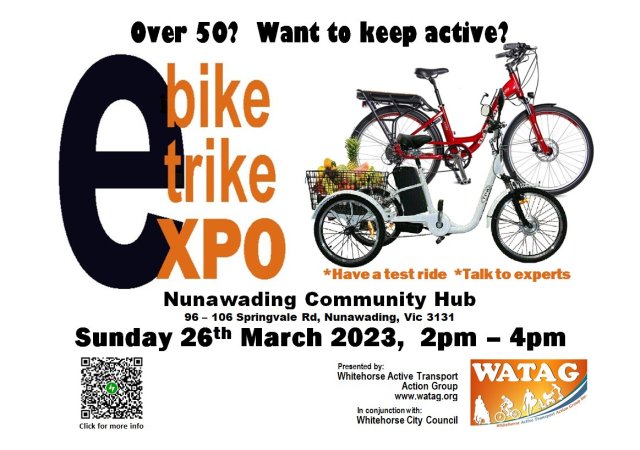
    Over 50’s Expo for e-bikes and trikes

    There’s no need to register or book beforehand. Just come along,and register when you arrive*

    Local enthusiasts who already ride non-standard two and three wheel bikes will be there to chat with you and let you see what’s available. And we’ll have bikes and trikes for you to test ride too.

    PLUS look for the Special Offers.

    E-bike specialists Sparque will have information about a range of packages to buy, salary package, lease or even rent for a month to really try out your new bike. AND a special try-before-you buy offer.

    The local branch of 99 Bikes – one of Australia’s largest bike stores – are terrific advocates for e-bikes. They will be there with some bikes to try and to give advice.

    Local specialist e-bike suppliers REV-Bikes will be there too with some bikes you may not have seen before

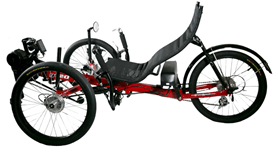
    For instance you might not be familiar with this type of recumbent bike, let alone had a chance to see one in action. It’s like riding in an armchair!

    You’ll be surprised at what’s available to help older folk who want to keep active but are a little unsure how to do this safely and in a way which meets their changing physical needs.

    And there is academic research to supports the use of e-trikes and e-bikes as a way to help older people stay active. For example:

    1. A study published in the Journal of Transport & Health found that e-bikes can increase physical activity levels in older adults, particularly among those who are less physically active.
    2. A study published in the International Journal of Environmental Research and Public Health found that e-bikes can have positive effects on older adults’ physical fitness and well-being, and can promote healthy aging.
    3. A systematic review published in the Journal of Medical Internet Research concluded that e-bikes have the potential to increase physical activity and reduce the risk of chronic disease in older adults.
    4. A study published in the journal “Transportation Research Part D: Transport and Environment” found that e-bikes can increase the level of physical activity among older adults and improve their mobility and independence.
    5. A study published in the “Journal of Transport and Health” found that e-bikes are a viable alternative mode of transportation for older adults, and can help to increase physical activity levels and improve quality of life.
    6. Another study published in the “International Journal of Sustainable Transportation” found that e-bikes can provide older adults with a more accessible and convenient form of transportation, which can lead to increased physical activity levels and improved health outcomes.
    7. Science Direct reported on “Physical activity of electric bicycle users compared to conventional bicycle users and non-cyclists” The study showed that •E-bikers take longer trips by e-bike and bicycle, compared to cyclists, •Physical activity gains from active travel are similar in e-bikers and cyclists.•Substituting all car trips with e-bike use leads to a g big gain in metabolic activity.• Transport modes substituted by the e-bike are still used frequently afterwards
    8. These studies suggest that e-bikes and e-trikes can be beneficial for older adults in Australia and provide evidence that supports their use as a way to help older people stay active. However, it is important to consider the specific needs and abilities of each individual before deciding to use an e-bike or e-trike, and to ensure that proper training and support are received for safe use.
      As a starting point. come to the EXPO!!

    It’s important to note that while these studies suggest that e-trikes and e-bikes can be beneficial for older adults, more research is needed to fully understand their impact on this population and to identify best practices for safe and effective use.

    This event is being run by WATAG in conjunction with Whitehorse City Council with support from bike suppliers, and local enthusiasts.

    Note the date in your diary now and we’ll see you there!

    (*We’ll need you to register your details so you can try out some of the bikes and trikes for yourself.)

    Posted in Active transport | 1 Comment